
FICA Tax Explained: What It Is, How It Works, and How It Affects Your Paycheck
Understand FICA taxes, including Social Security and Medicare taxes, how they are calculated, and how they affect employee paychecks and employer payroll obligations.
 Charles Hardy
 Updated on Sep 30, 2026
 12 min read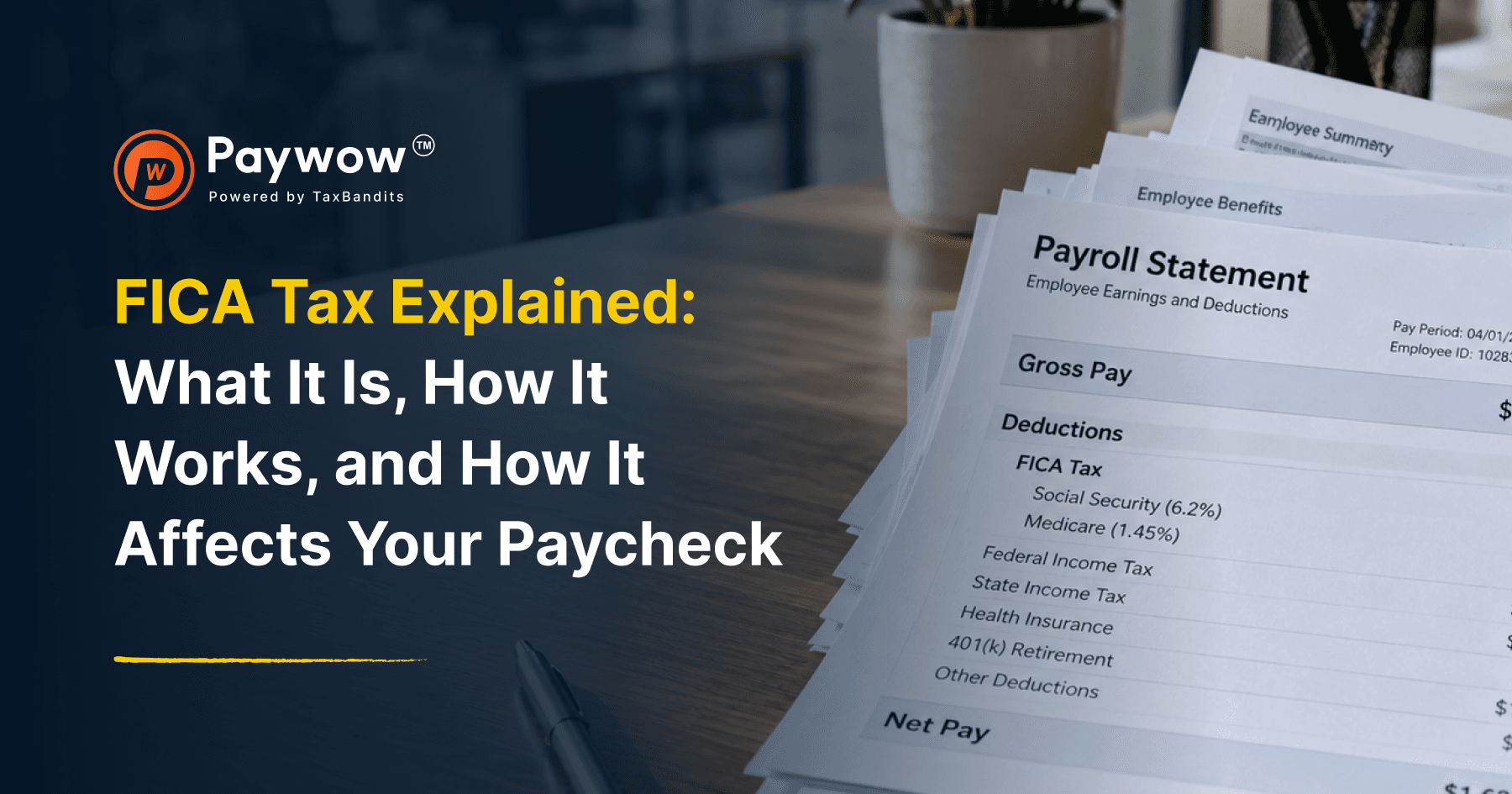
Scannable summary
Key Takeaways
- FICA tax funds Social Security and Medicare and is generally shared equally between employees and employers.
- Social Security and Medicare have different tax rates and wage rules, including an annual Social Security wage base.
- Employees earning above $200,000 in wages are subject to an additional 0.9% Medicare Tax on wages above the threshold.
- Employers pay their own share of FICA taxes in addition to the employee’s withholding, making FICA an important part of total payroll costs.
- FICA typically appears on pay stubs as Social Security and Medicare deductions, helping employees understand how these taxes affect their take-home pay.
FICA stands for the Federal Insurance Contributions Act, and it’s the payroll tax that funds Social Security and Medicare. Both employees and employers pay it, split evenly, and it applies to almost every paycheck in the country regardless of industry or income level.
Here’s exactly how it works and what it means for your take-home pay.
What FICA actually pays for
FICA isn’t one tax; it’s two combined into a single deduction:
-
Social Security tax, which funds retirement, disability, and survivor benefits
-
Medicare tax, which funds hospital insurance for people 65 and older, and some younger people with disabilities
Both are mandatory. Neither is optional, regardless of how much you earn or how long you’ve worked.
How much FICA actually costs
For 2026, the FICA breakdown is:
|
Tax |
Employee rate |
Employer rate |
Wage base |
|---|---|---|---|
|
Social Security |
6.2% |
6.2% |
First $184,500 of wages |
|
Medicare |
1.45% |
1.45% |
No cap |
|
Additional Medicare |
0.9% |
None |
Wages above $200,000 |
Combined, employees and employers each pay 7.65% on wages up to the Social Security wage base. Above $184,500, Social Security tax stops for the year, but Medicare tax continues on every additional dollar, with no ceiling.

The additional Medicare tax
Once an employee’s wages exceed $200,000 in a calendar year, an extra 0.9% Additional Medicare Tax applies to everything above that threshold. This portion is withheld from the employee only, employers don’t match it. It’s also based purely on wages from a single employer, so someone who crosses $200,000 across two jobs may owe more when they file their return, even if neither employer withheld the additional amount individually.
Why employers pay FICA too
Every dollar an employee sees withheld for FICA has a matching dollar the employer pays separately, on top of the employee’s gross wages. This employer match doesn’t come out of the employee’s paycheck. It’s an additional payroll cost the business absorbs, which is part of why FICA rates matter for budgeting labor costs, not just for take-home pay.
Who’s exempt from FICA
A few narrow categories of workers are exempt from FICA, including certain student workers employed by the school they attend, and some religious organization employees who’ve filed for an exemption. Independent contractors don’t have FICA withheld either, but they pay the equivalent through self-employment tax, which covers both the employee and employer share at a combined 15.3%.
How FICA shows up on your pay stub
Most pay stubs list FICA as two separate lines rather than one combined figure:
-
Social Security (or OASDI), typically 6.2% of gross wages
-
Medicare, typically 1.45% of gross wages
If you see an additional line labeled Medicare surtax or Additional Medicare, that means your year-to-date wages have crossed the $200,000 threshold.
A quick example
An employee earning $90,000 a year in 2026 pays:
-
Social Security: $90,000 × 6.2% = $5,580
-
Medicare: $90,000 × 1.45% = $1,305
-
Total FICA withheld: $6,885
Their employer pays a matching $6,885 on top, meaning the true payroll cost of that employee’s FICA obligation is $13,770 combined, even though the employee only sees the $6,885 reflected in their own paycheck.
Why FICA matters beyond your paycheck
FICA isn’t just a deduction, it’s a direct contribution to benefits you or your family may eventually rely on. The taxes withheld from today’s paycheck fund current retirees’ Social Security checks and Medicare coverage, under a pay-as-you-go structure, which is why the wage base and rates are reviewed and adjusted almost every year.
Understanding FICA doesn’t change how much you owe, the rate is fixed and mandatory, but it does explain exactly where a meaningful chunk of every paycheck goes, and why that number looks a little different once your earnings cross certain thresholds.
Knowing the FICA math is one thing, calculating it correctly on every paycheck is another. PayWow applies the current Social Security and Medicare rates automatically, including the additional Medicare surtax once an employee crosses the threshold.
Related Blogs