FUTA vs. SUTA: What’s the Difference Between Federal and State Unemployment Taxes?
Understand the differences between FUTA and SUTA, including federal and state unemployment taxes, employer responsibilities, and how they apply to payroll.
 Charles Hardy
 Updated on Sep 30, 2026
 12 min read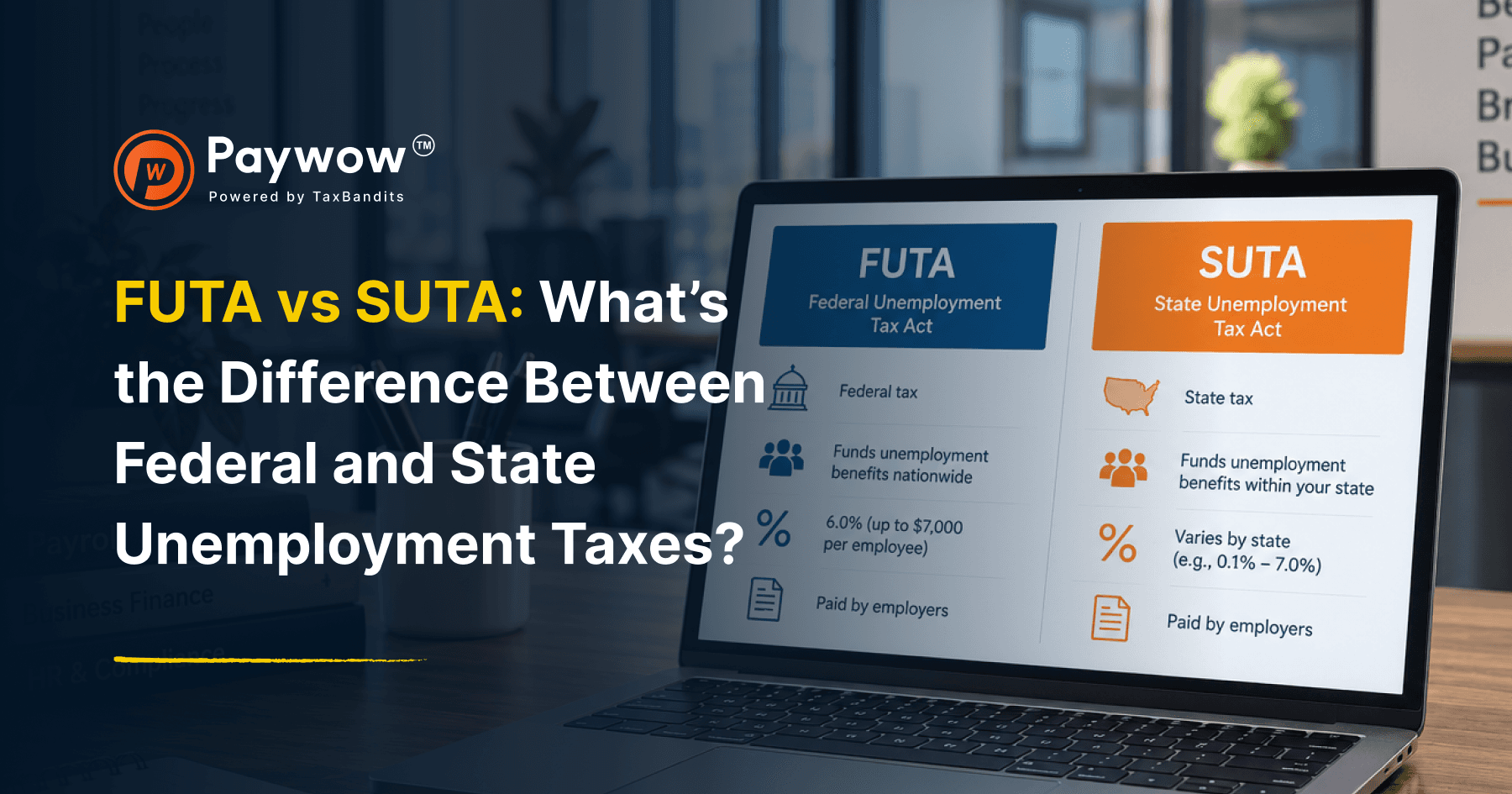
Scannable summary
Key Takeaways
- FUTA is a federal employer-paid unemployment tax, while SUTA is a state unemployment tax with rules that vary by state.
- FUTA generally applies at 6.0% on the first $7,000 of wages, with a credit of up to 5.4% for eligible employers that pay state unemployment taxes on time.
- SUTA rates and wage bases vary by state and may also depend on an employer’s unemployment claims history.
- FUTA and SUTA use different wage bases, tax rates, and filing requirements, so employers must track both separately.
- Paying SUTA on time can help employers maintain the available FUTA credit and avoid additional federal unemployment tax costs.
Every paycheck you issue quietly funds two separate unemployment insurance systems at once, one federal, one state, and most employers couldn’t tell you where one ends and the other begins.
FUTA is the federal unemployment tax, paid entirely by employers at 6.0% on the first $7,000 of each employee’s wages, while SUTA is the state-level equivalent, with rates and wage bases that vary by state and by the employer’s own claims history. Here’s how the two actually work together.
What FUTA is
FUTA, the Federal Unemployment Tax Act, funds a portion of the federal unemployment insurance system and is reported annually on Form 940. Only employers pay FUTA, it’s never withheld from employee wages.
For 2026, the FUTA rate is 6.0% on the first $7,000 of each employee’s wages for the year. Once an employee’s wages exceed $7,000 in the calendar year, FUTA tax stops for that employee, regardless of how much more they earn.
The FUTA credit that changes the real rate
Most employers never actually pay the full 6.0% rate. If you pay your state unemployment taxes in full and on time, you’re eligible for a credit of up to 5.4%, bringing the effective FUTA rate down to just 0.6%, or a maximum of $42 per employee per year.

What SUTA is
SUTA, the State Unemployment Tax Act, is essentially FUTA’s state-level counterpart. It funds each state’s own unemployment insurance program, which pays benefits to workers who lose their jobs through no fault of their own.
Unlike FUTA, SUTA rates and wage bases vary significantly by state, and in most states, by the individual employer’s own history of unemployment claims, known as an experience rating. Employers with fewer former employees filing unemployment claims generally pay lower SUTA rates over time, while employers with a history of frequent claims pay higher rates.
Side-by-side comparison
|
FUTA |
SUTA |
|
|---|---|---|
|
Level |
Federal |
State |
|
Who pays |
Employer only |
Employer only, in nearly all states |
|
Standard rate |
6.0%, reduced to 0.6% with full credit |
Varies by state, often 0% to 12%+ |
|
Wage base |
$7,000 (federal minimum) |
Varies by state, often higher than $7,000 |
|
Filing form |
Form 940 (annual) |
State-specific, usually quarterly |
|
Rate determined by |
Fixed federal rate and credit |
State rate table plus employer experience rating |
Why the wage base differs between the two
FUTA’s $7,000 wage base is a federal floor, states must set their SUTA wage base at least $7,000, but most set it significantly higher. This means SUTA is often calculated on a larger portion of each employee’s wages than FUTA, even though FUTA gets more attention since it’s a federal filing.
Credit reduction states
If a state has borrowed federal funds to cover its unemployment insurance obligations and hasn’t repaid that loan by a set deadline, the IRS can reduce the FUTA credit available to employers in that state, effectively raising their FUTA rate above the standard 0.6%. This is reported on Schedule A of Form 940, and it’s worth checking annually, since credit reduction states can change from year to year based on loan repayment status.
How the two interact in practice
Here’s a simplified example for an employee earning $50,000 a year, assuming a state SUTA wage base of $10,000 and a moderate employer SUTA rate of 2%:
|
Tax |
Wage base applied |
Rate |
Amount owed |
|---|---|---|---|
|
FUTA |
$7,000 |
0.6% (with full credit) |
$42.00 |
|
SUTA |
$10,000 |
2.0% (example rate) |
$200.00 |
Both taxes apply to the same employee, calculated independently, using different wage bases and different rates.
Filing deadlines to track
Form 940 for a given tax year is generally due by January 31 of the following year, though employers who deposited all FUTA tax on time get an extended deadline into early February. SUTA filings follow each state’s own schedule, typically quarterly, and are separate from the federal Form 940 filing entirely.
The bottom line
FUTA and SUTA fund the same broad purpose, unemployment insurance, but they operate as two entirely separate tax obligations with different rates, different wage bases, and different filing requirements. Paying your SUTA taxes on time isn’t just a state compliance matter, it’s also what keeps your federal FUTA rate at the reduced 0.6% instead of the full 6.0%, which makes the two taxes more connected than most employers realize until they actually sit down and calculate both.
Related Blogs