
Net pay is the amount an employee takes home after taxes and deductions are subtracted from gross pay. Learn what affects net pay, how to calculate it step by step, and how it differs from gross pay.
By Charles Hardy Last updated Nov 27, 2026
Quick answer: Net pay is the amount an employee takes home after taxes and deductions are subtracted from gross pay. It is also called take-home pay and represents the amount paid to the employee through direct deposit or a paycheck.
Net pay is the amount remaining from an employee’s gross earnings after applicable taxes and deductions are withheld. Employers calculate net pay during payroll processing, and employees receive this amount through direct deposit or a paycheck. It is commonly referred to as take-home pay.
The amount an individual employee receives after applicable taxes and deductions for a pay period.
The combined net pay of every employee for a pay period. This is the cash an employer needs available on payday.
The payment an employee receives through a physical check or direct deposit, representing their net pay.
Several types of deductions and taxes affect the amount an employee receives from gross pay. These include pre-tax deductions, mandatory payroll taxes, and post-tax deductions. Employers also pay separate payroll taxes and benefit costs that do not reduce an employee’s net pay.
| Group | Examples | Effect on net pay |
|---|---|---|
| Pre-tax deductions | Qualifying health, dental and vision premiums, HSA/FSA contributions, traditional 401(k) contributions, eligible commuter benefits | Reduce net pay and may reduce certain taxable wages depending on the deduction |
| Mandatory taxes | Federal income tax withholding, Social Security, Medicare, state and local income tax where applicable | Reduce the employee’s take-home pay |
| Post-tax deductions | Roth 401(k) contributions, union dues, wage garnishments, charitable contributions, applicable after-tax insurance premiums | Reduce net pay after applicable tax withholding |
| Employer-paid costs | Employer Social Security and Medicare contributions, federal and state unemployment taxes, employer benefit contributions | Increase employer payroll costs but do not reduce employee net pay |

Net pay = Gross pay − Pre-tax deductions − Employee taxes withheld − Post-tax deductions
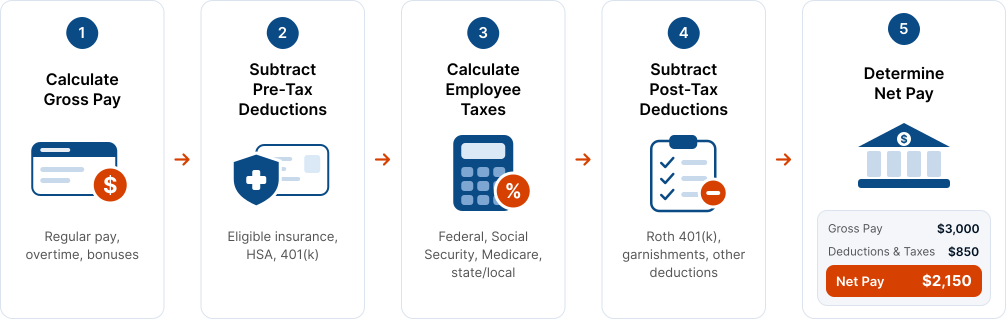
For hourly employees, multiply the hourly rate by hours worked and add overtime, bonuses, commissions, and other applicable earnings.
For salaried employees, divide the annual salary by the number of pay periods in the year.
Account for qualifying health insurance premiums, HSA and FSA contributions, traditional 401(k) contributions, and other eligible deductions.
Determine federal income tax withholding using the employee’s Form W-4 and applicable withholding methods. Calculate Social Security, Medicare, and applicable state and local taxes using their respective taxable wage amounts.
Deduct applicable after-tax items, such as Roth 401(k) contributions, union dues, garnishments, and after-tax insurance premiums.
The remaining amount is the employee’s net pay, which is paid through direct deposit or a paycheck.
Marcus earns $21 per hour and works 80 regular hours plus 4 overtime hours at $31.50 per hour during a biweekly pay period. He also contributes $95 toward a qualifying pre-tax health insurance plan.
| Regular pay: $21 × 80 hours | $1,680.00 |
| Overtime: $31.50 × 4 hours | $126.00 |
| Gross pay | $1,806.00 |
| Health premium (pre-tax) | −$95.00 |
| Social Security: 6.2% of $1,711 | −$106.08 |
| Medicare: 1.45% of $1,711 | −$24.81 |
| Federal income tax (per W-4) | −$142.00 |
| State income tax: 3% of $1,711 | −$51.33 |
| Net pay | $1,386.78 |
John earns an annual salary of $78,000 and is paid semi-monthly, resulting in gross pay of $3,250 per pay period. He contributes $150 toward qualifying pre-tax health coverage and 6% of his gross pay toward a traditional 401(k) plan.
| Gross pay: $78,000 ÷ 24 periods | $3,250.00 |
| Health premium (pre-tax) | −$150.00 |
| Traditional 401(k): 6% of gross | −$195.00 |
| Social Security: 6.2% of $3,100 | −$192.20 |
| Medicare: 1.45% of $3,100 | −$44.95 |
| Federal income tax (per W-4) | −$268.00 |
| State income tax: 4% of $2,905 | −$116.20 |
| Life insurance (post-tax) | −$12.00 |
| Net pay | $2,271.65 |

No spreadsheets required. Paywow helps calculate employee earnings, apply payroll deductions, and determine net pay before you approve each payroll run.
Net payroll is the total net pay for every employee in a pay period, which makes it the amount an employer has to have in the bank for payday. It is smaller than gross payroll, and smaller than the real cost of the pay run, because withheld taxes and the employer’s own payroll taxes leave the account separately on the deposit schedule.
| One pay period, five employees | Amount |
|---|---|
| Gross payroll | $18,400.00 |
| Pre-tax deductions | −$800.00 |
| Employee taxes withheld | −$3,620.00 |
| Post-tax deductions | −$500.00 |
| Net payroll paid to employees | $13,480.00 |
| Employer Social Security and Medicare: 7.65% of $17,600 | $1,346.40 |
| Federal and state unemployment tax | $160.00 |
| Total employer cost for the run | $19,906.40 |
Gross pay is what an employee earns. Net pay is what the employee receives. Every payroll calculation starts at the first figure and ends at the second.
| Element | Gross pay | Net pay |
|---|---|---|
| What it measures | Total earnings for the pay period | Money actually paid to the employee |
| Taxes and deductions | Not yet subtracted | Already subtracted |
| On the pay stub | Top of the earnings section | Final line, often labeled take-home pay |
| Used for | Overtime math, tax calculations, wage reporting, income verification | Budgeting, rent and loan affordability, the deposit amount |
| Formula | Rate × hours, or salary ÷ pay periods, plus extras | Gross pay − pre-tax deductions − taxes − post-tax deductions |
Identical gross pay rarely produces identical net pay. Four factors explain most of the difference between two employees, and most of the movement from one paycheck to the next.
Filing status, dependents and any extra withholding requested set the federal income tax amount. Two people on the same salary can take home different amounts from this alone.
Contributions toward health coverage, qualifying HSA and FSA plans, and retirement savings can affect an employee’s net pay. The impact on taxable wages depends on the type of deduction and applicable tax rules.
State and local income tax rates differ, and several states levy no income tax at all, so location changes net pay on identical gross pay.
More pay periods mean smaller checks. Bonuses and commissions raise gross pay, but supplemental wages are often withheld at a flat federal rate, so the net increase looks smaller than expected.
Employers must ensure sufficient funds are available to cover employee net pay and meet payroll processing deadlines. Direct deposit submission timelines depend on the payment method, bank, and payroll provider.
Employers must follow federal and state laws when making deductions from employee wages. Voluntary deductions may require employee authorization, and certain deductions are subject to legal restrictions.
Federal and state laws limit wage garnishments, with different rules for child support, tax levies, and other debts. Employers must follow applicable withholding limits and the requirements of each order.
When every deduction is itemized, employees can see why net pay changed without raising a ticket, and payroll spends less time reconstructing old runs.
 Applying deductions in the wrong order. Taking post-tax items before taxes overstates withholding and understates net pay.Treating every pre-tax deduction the same way. Section 125 premiums are exempt from Social Security and Medicare; traditional 401(k) deferrals are not.Funding payday with the net figure only. The withheld taxes and the employer share still have to leave the account on the deposit schedule.Missing garnishment limits or priority. Withholding above the federal cap, or paying a lower-priority order first, creates a correction and often a liability.Processing a W-4 or benefit change late. A change that arrives after the run is locked has to wait for the next period, and employees notice it in their net pay.Rounding each line separately. Small rounding differences accumulate across the year and show up as reconciliation work at W-2 time.
Managing payroll involves more than calculating employee earnings. Employers must also account for deductions, tax withholding, and the final amount employees receive.
Enter employee hours or salary to calculate gross pay, including applicable overtime and additional earnings.
Manage applicable payroll deductions and tax withholding based on employee information and payroll settings.
Calculate employee net pay and provide pay statements showing earnings, deductions, and withholding details.
Manage employee earnings, payroll deductions, and tax withholding with Paywow. Make payroll processing easier and
keep employee pay calculations organized.


