
Overtime pay is additional compensation for eligible employees who work beyond standard working hours. Learn how overtime works, who qualifies, and how to calculate overtime pay under the FLSA.
By Charles Hardy Last updated Nov 27, 2026
Quick answer: Overtime pay is the additional compensation paid to eligible employees for working beyond legally established hours. Under federal FLSA rules, covered, non-exempt employees must receive at least 1.5 times their regular rate of pay for hours worked over 40 in a workweek. Some states also require overtime for working beyond a specified number of hours in a day.
Overtime is time worked by a non-exempt employee beyond the applicable overtime threshold. Under the FLSA, covered, non-exempt employees generally earn overtime for hours worked beyond 40 in a fixed workweek.
A workweek is a fixed, recurring period of 168 hours, consisting of seven consecutive 24-hour days. Employers can begin their workweek on any day and at any hour. It does not have to match the calendar week or the employee’s pay period.
Only hours that qualify as hours worked under applicable federal and state laws count toward overtime calculations. Paid time off, such as vacation and sick leave, generally does not count as hours worked under federal law.
 Hours actually worked, scheduled or notRequired training, meetings and opening or closing dutiesShort rest breaks of roughly 20 minutes or lessTravel between work sites during the workdayWork done off the clock that you know about or should know about
 Holiday, vacation, PTO and sick payMeal periods of 30 minutes or more when the employee is fully relieved of dutyThe ordinary commute from home to workHours paid but not worked under a company policy
The FLSA is the federal law that sets overtime. Section 7 requires covered employers to pay non-exempt employees at least one and a half times their regular rate for every hour over 40 in a workweek. The U.S. Department of Labor enforces it, and it applies in every state.
| Rule | Federal requirement | Explanation |
|---|---|---|
| Overtime after 40 hours | Required | Covered, non-exempt employees must receive overtime for hours worked over 40 in a workweek. |
| Overtime after 8 hours in a day | Not generally required | Federal law uses a weekly threshold. Some state laws require daily overtime. |
| Time-and-a-half pay | Required | At least 1.5 times the employee’s regular rate of pay. |
| Double-time pay | Not required | Federal law does not generally require double-time compensation. |
| Extra pay for weekends and holidays | Not required | Premium pay is not required unless overtime hours are worked or another applicable rule or agreement requires it. |
| Maximum weekly hours for employees aged 16 and older | No general federal limit | Employers must still comply with applicable overtime and other workplace laws. |
| Averaging hours across two workweeks | Not permitted | Each workweek is calculated separately, even for biweekly payroll. |
| Overtime payment timing | Required | Overtime generally must be paid on the regular payday for the pay period in which the wages were earned. |

Biweekly payroll, two separate weeks An employee who works 48 hours one week and 32 the next has worked 80 hours in the period, but 8 of them are overtime. You cannot offset a short week against a long one.
Under the FLSA, employees are generally entitled to overtime unless they qualify for an applicable exemption. Being paid a salary or having a managerial job title does not automatically make an employee exempt.
The federal salary and duties tests vary for certain occupations and exemptions. Outside sales employees, certain computer employees, teachers, doctors, lawyers, and other occupations may be subject to different exemption requirements. Employers should evaluate the specific exemption rather than relying on job titles or salary alone.
Manages the business or a department, regularly directs at least two full-time employees, and has real say in hiring and firing.
Office work tied to business operations, with independent judgment on matters of significance. Routine clerical work does not qualify.
Work requires advanced knowledge in a field of science or learning, usually from prolonged specialized study, or genuine creative work.
The regular rate of pay is the hourly rate used to calculate overtime compensation. It may be different from an employee’s base hourly wage because it can include additional compensation, such as nondiscretionary bonuses, commissions, and certain shift differentials.
Under the FLSA, the regular rate generally includes compensation for employment unless a specific statutory exclusion applies.
Regular rate of pay = Total includable compensation for the workweek ÷ Total hours worked in the workweek
| Pay type | Generally included? | Explanation |
|---|---|---|
| Hourly wages | Yes | Regular hourly earnings are included. |
| Salary | Yes | For non-exempt salaried employees, the salary must be converted into an applicable regular rate based on the compensation arrangement. |
| Nondiscretionary bonuses | Yes | Production, attendance, and performance bonuses generally count. |
| Shift differentials | Yes | Additional compensation for certain shifts generally counts. |
| Commissions | Yes | Commissions generally must be included in the regular rate. |
| Discretionary bonuses | Generally no | Only bonuses that meet the FLSA’s specific discretionary bonus requirements are excluded. |
| Certain holiday gifts | Generally no | Genuine gifts or special-occasion payments may be excluded when statutory conditions are met. |
| Vacation and sick pay | Generally no | Payments for time not worked are generally excluded. |
| Expense reimbursements | Generally no | Genuine business expense reimbursements are generally excluded. |
| Employer benefit contributions | Generally no | Qualifying contributions to benefit plans are generally excluded. |
Some payments that appear discretionary may still be included in the regular rate. The exclusion depends on the actual payment arrangement and the statutory requirements, not simply the label assigned by the employer.
Calculating overtime pay involves determining the employee's total hours worked, calculating their regular rate of pay, and applying the applicable overtime premium.
Count the hours worked during the employee's fixed workweek. Exclude paid leave that does not qualify as hours worked.
Include applicable hourly wages, salary, nondiscretionary bonuses, commissions, and other compensation required under the FLSA.
Subtract 40 hours from the total hours worked for the week. Apply any additional state overtime requirements where applicable.
For a standard hourly employee already paid straight-time wages for all hours worked, calculate the additional overtime premium using half the regular rate for each overtime hour. If straight-time pay has not already been included, the full 1.5-times rate may be due
Add regular earnings and the applicable overtime compensation.
Overtime pay = (regular rate × 1.5) × overtime hours
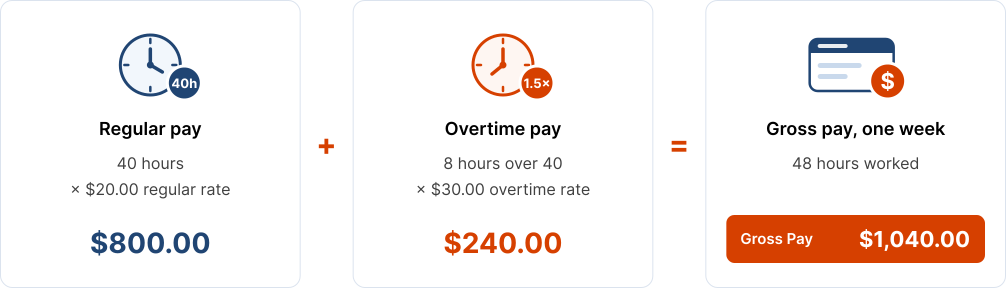
John earns $20.00 an hour and works 48 hours in one workweek.
| Regular pay: 40 hours × $20.00 | $800.00 |
| Overtime rate: $20.00 × 1.5 | $30.00 |
| Overtime pay: 8 hours × $30.00 | $240.00 |
| Gross pay for the week | $1,040.00 |
John earns $20.00 an hour, works 45 hours and receives a $100 production bonus that was promised in advance. The bonus has to go into the regular rate first.
| Straight-time earnings: (45 × $20.00) + $100.00 | $1,000.00 |
| Regular rate: $1,000.00 ÷ 45 hours | $22.22 |
| Overtime premium: $22.22 × 0.5 × 5 hours | $55.56 |
| Total due for the week | $1,055.56 |
Priya is paid a $48,000 salary for a 40-hour week and fails the duties test, so she is non-exempt. She works 44 hours.
| Weekly salary: $48,000 ÷ 52 | $923.08 |
| Regular rate: $923.08 ÷ 40 hours | $23.08 |
| Overtime pay: 4 hours × ($23.08 × 1.5) | $138.46 |
| Gross pay for the week | $1,061.54 |
Dana works 30 hours as a server at $18.00 and 15 hours behind the bar at $22.00. Federal rules use a weighted average of the two rates.
| Straight-time earnings: (30 × $18.00) + (15 × $22.00) | $870.00 |
| Weighted regular rate: $870.00 ÷ 45 hours | $19.33 |
| Overtime premium: $19.33 × 0.5 × 5 hours | $48.33 |
| Total due for the week | $918.33 |

Paywow splits each pay period into workweeks and applies the overtime rate to the hours that earned it.
Overtime and double time are different levels of premium compensation. Under the FLSA, covered, non-exempt employees generally receive at least 1.5 times their regular rate for hours worked beyond 40 in a workweek. Federal law does not generally require double-time pay. However, California law requires double time in certain situations.
| COMPARISION | Overtime (time and a half) | Double time |
|---|---|---|
| Rate | 1.5 × the regular rate | 2 × the regular rate |
| Federal requirement | Required for qualifying hours over 40 in a workweek | Not generally required |
| Common trigger | More than 40 hours in a workweek | Certain extended workdays in California |
| California daily rule | More than 8 hours up to 12 hours | More than 12 hours in a workday |
| California seventh-day rule | First 8 hours on the seventh consecutive workday | Hours beyond 8 on the seventh consecutive workday |
| Other requirements | May be required by state law | May be required by an employer policy or employment agreement |
Federal overtime law establishes the minimum overtime requirements for covered employees. However, some states have additional requirements, including daily overtime, seventh-day overtime, or industry-specific rules.
When federal and state overtime laws both apply, employers must comply with the applicable requirements that provide employees with greater protection.
| State | Trigger beyond the federal 40-hour week | Rate |
|---|---|---|
| California | Over 8 hours in a workday, and the first 8 hours on the 7th consecutive workday | 1.5× |
| California | Over 12 hours in a workday, and past 8 hours on the 7th consecutive workday | 2× |
| Alaska | Over 8 hours in a workday, at employers with 4 or more employees | 1.5× |
| Nevada | Over 8 hours in a 24-hour period, for employees paid under 1.5× the state minimum wage | 1.5× |
| Colorado | Over 12 hours in a workday or 12 consecutive hours, whichever gives the greater amount | 1.5× |
| Oregon | Over 10 hours in a day in manufacturing establishments | 1.5× |
| Kentucky | The 7th consecutive day worked in a workweek | 1.5× |
State overtime requirements may vary by industry, employee classification, employer size, and applicable exemptions. Employers should review the relevant state labor department guidance before calculating overtime.
Getting the math right is half the job. These rules decide whether the payment itself holds up.
Pay overtime on the regular payday for the pay period in which the extra hours were worked, following applicable federal and state payment requirements.
Pay employees for overtime hours you know or should know they have worked, even if they did not receive prior approval.
Employees cannot give up their legal right to overtime pay through an agreement or workplace policy.
Private-sector employers generally cannot replace required overtime pay with paid time off. Certain public-sector employers may offer compensatory time under specific conditions.
Treating a salary as proof of exemption: Salary is one test of three, and the duties test is where most classifications fail.Averaging hours across a two-week pay period: 48 hours and 32 hours is still 8 hours of overtime.Leaving bonuses and differentials out of the regular rate: The overtime rate has to be rebuilt for every week they affect.Ignoring off-the-clock work: Evening email and pre-shift setup count once you know, or should know, that it happens.Applying the federal threshold in a higher-threshold state: A $60,000 manager can be exempt in Texas and non-exempt in Washington.Rounding time records down to stay under 40: Rounding has to be neutral over time, never one-directional.Offering comp time in a private company: It is a public sector option only.Managing employee overtime requires accurate time tracking, regular-rate calculations, and proper payroll processing. Paywow helps businesses simplify payroll calculations and manage employee earnings in one place.
Calculate employee earnings, including regular hours and applicable overtime compensation, to help maintain accurate payroll records.
Keep regular wages, overtime earnings, bonuses, and other compensation organized for easier payroll review.
Manage employee earnings, applicable tax withholding, and payroll calculations through a streamlined payroll process.
Calculate employee overtime, manage payroll taxes and deductions, and streamline every pay run with Paywow.


