
A pay period is the set range of dates for which an employee earns wages. Learn how different
pay schedules work and how pay periods, pay cycles, and pay dates differ.
By Charles Hardy Last Updated: November 27, 2026
Quick answer: A pay period is a recurring period of time during which an employee works and earns wages. It determines which work hours and earnings are included in a paycheck. Employers commonly use weekly, biweekly, semimonthly, or monthly pay periods.
A pay period follows a regular schedule. Employees work during the defined period, employers review their hours and earnings, payroll is processed, and employees receive their payments on the scheduled payday.

Employees work their scheduled hours during the pay period.

Employers review timesheets, overtime, leave, and other earnings.

Gross pay, taxes, deductions, and net pay are calculated.

Employees receive their wages through direct deposit or check.
| Term | Meaning | Example |
|---|---|---|
| Pay period | The dates for which an employee earns wages. | November 2–15 |
| Pay cycle | The recurring payroll process, from collecting work hours to paying employees. | Review, calculate, approve, and pay payroll |
| Pay schedule | The employer's planned calendar of pay periods and paydays. | Every other Friday |
| Pay frequency | How often employees receive their wages. | Weekly or biweekly |
| Processing date | The date the employer processes and submits payroll. | November 18 |
| Pay date | The date employees receive their wages. | November 20 |
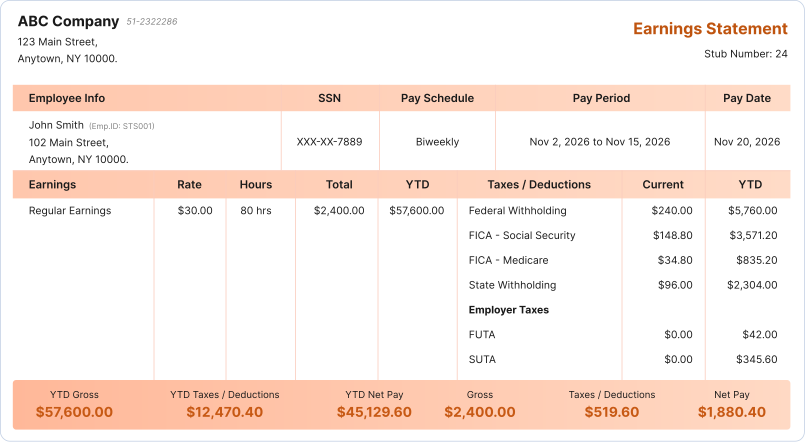
There are four standard pay frequencies. Each one produces a different number of pay periods.
52
pay periods a year
Paid every week, usually on the same weekday.
26
pay periods a year
Paid every two weeks on the same weekday.
24
pay periods a year
Paid twice a month on set dates.
12
pay periods a year
Paid once a month, often on the last business day.
| Feature | Biweekly | Semimonthly |
|---|---|---|
| Payment frequency | Every two weeks | Twice a month |
| Annual pay periods | Usually 26 | 24 |
| Paydays | Same weekday every two weeks | Usually fixed calendar dates |
| Period length | Always 14 days | Varies by month |
| Hourly payroll | Hours vary based on actual work | Hours vary based on actual work |
| Salaried payroll | Annual salary divided by 26 | Annual salary divided by 24 |

When a pay stub, offer letter or benefits form says an amount is “per pay period,” it applies once to each pay cycle, not to the year. That is why the number of pay periods matters.
Pay per period = annual salary ÷ pay periods per year
| Schedule | Periods | Gross per period on $60,000 |
|---|---|---|
| Weekly | 52 | $1,153.85 |
| Biweekly | 26 | $2,307.69 |
| Semimonthly | 24 | $2,500.00 |
| Monthly | 12 | $5,000.00 |
For hourly staff, multiply the hourly rate by hours worked in the period. At $30 an hour, a biweekly period is 80 × $30 = $2,400 in gross pay, before overtime. Overtime pay is calculated per workweek, not per pay period.
| Pay schedule | Pay period | Payroll processing | Pay date |
|---|---|---|---|
| Weekly | Nov 2–8 | Nov 9 | Nov 13 |
| Biweekly | Nov 2–15 | Nov 18 | Nov 20 |
| Semimonthly | Nov 1–15 | Nov 18 | Nov 20 |
When a scheduled payday falls on a weekend or holiday, employers should follow their established payroll policy and applicable state payday laws. Depending on the requirements, employers may need to issue payments on the preceding business day or make other arrangements to ensure employees receive their wages on time.

Schedule payments according to the company's established payday policy and applicable state requirements.

Allow additional processing time because banks and payment systems may not process transactions normally.

Check whether banking services are available and ensure employees receive their wages on time.
Off-cycle payroll is a payroll run processed outside an employer's regular pay schedule. It allows employers to issue payments when employees cannot wait until the next scheduled payday.
A full payroll cycle includes all the activities required to calculate, process, and pay employee wages for a particular pay period. It starts with collecting employee work information and ends with payroll reporting and recordkeeping.
Gather timesheets, attendance, new-hire details, and employee updates.
Calculate regular wages, overtime, bonuses, and other earnings.
Determine applicable federal, state, and local taxes, along with benefit deductions.
Issue payments through direct deposit or checks and provide pay stubs.
Make required tax deposits and submit applicable payroll tax returns.
Keep payroll records and prepare year-end tax documents, including Form W-2.
Choosing the right pay schedule depends on your workforce, payroll processing capabilities, business operations, and state wage-payment requirements.
| Business requirement | Suggested pay schedule |
|---|---|
| Employees with variable weekly hours | Weekly or biweekly |
| Businesses with mostly salaried employees | Semimonthly or biweekly |
| Businesses looking to reduce payroll processing frequency | Biweekly or semimonthly, where permitted |
| Businesses with strict state payday requirements | A schedule that meets state regulations |
| Businesses with employees working different shifts | A schedule supported by reliable time tracking |
 State and federal payday requirements.Employee classifications and overtime calculations.Payroll processing time and approval deadlines.Benefits and deductions per pay period.Employee payment preferences and cash-flow needs.
More frequent pay schedules require employers to process payroll more often
Employers must calculate overtime using the applicable workweek, even when the pay period spans multiple workweeks.
The amount deducted from each paycheck can vary depending on whether the employee is paid 24 or 26 times a year.
Pay frequency affects how often employees receive their income and plan their expenses.
 Confusing pay periods with pay dates: Clearly define the work dates covered by each paycheck.Using the wrong salary calculation: Divide annual salary by the correct number of pay periods.Ignoring state payday requirements: Confirm that the selected pay frequency complies with state law.Calculating overtime incorrectly: Calculate overtime based on the workweek, not the pay period.Not accounting for bank holidays: Plan payroll submissions and employee payments ahead of holidays.
Simplify payroll management with Paywow. Set up employee pay schedules, calculate wages and deductions, and process payroll with an organized payroll workflow.
Manage weekly, biweekly, semimonthly, and monthly payroll schedules.
Calculate employee wages, taxes, and deductions.
Review and process payroll while keeping payment schedules organized.
Let Paywow handle schedules, calculations and taxes so every paycheck is right.

