
Double time pay is twice an employee’s regular rate of pay. Learn when double time applies, how it differs from standard overtime, who qualifies, and how to calculate double time wages.
By Charles Hardy Last Updated: Nov 27, 2026
Quick answer: Double time pay is twice an employee’s regular rate of pay, or a 2× multiplier, compared with the 1.5× rate used for standard overtime. Federal law does not generally require double time pay. It may apply under state law, a collective bargaining agreement, an employment agreement, or an applicable employer policy.
Both are premium rates for extra hours, but they come from different places and are triggered by different things. Standard overtime is a federal floor that applies nationwide. Double time is an exception that applies only where a specific law, contract or policy creates it.

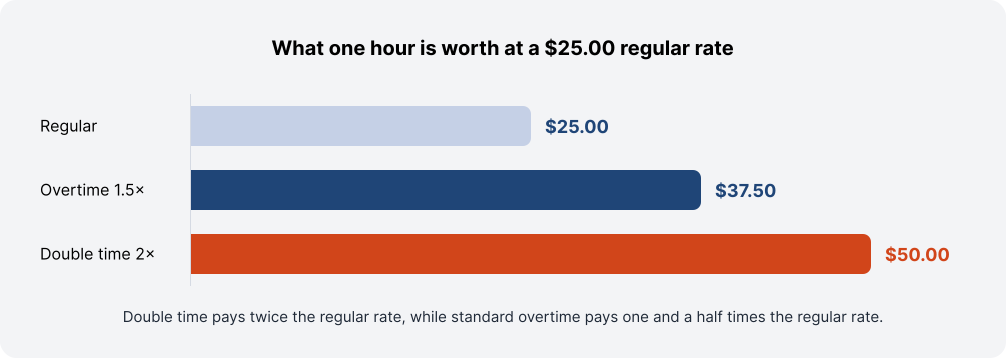
Regular rate
$25.00 an hour

Overtime
$37.50 an hour

Double time
$50.00 an hour
| Topic | Overtime (time-and-a-half) | Double time |
|---|---|---|
| Multiplier | 1.5× the regular rate | 2× the regular rate |
| Required by federal law? | Yes, for nonexempt employees over 40 hours a week | No — the FLSA has no double time requirement |
| Usual trigger | Hours over 40 in a workweek, plus daily rules in a few states | Hours over 12 in a workday in California, or whatever a contract or policy specifies |
| Rate on a $25 regular rate | $37.50 an hour | $50.00 an hour |
| Who sets the rule | The FLSA, plus state wage and hour law | California wage orders, union contracts, employment agreements, employer policy |
| Applies to exempt staff? | No | No, unless the employer chooses to pay it |
For a full explanation of the 1.5× rate and how the 40-hour threshold works, see our guide to overtime pay.
The FLSA does not establish a general second-tier overtime rate of 2×. It also does not generally require premium pay solely for weekend, holiday, or night-shift work. However, state laws, employment agreements, and employer policies may provide additional compensation.
The U.S. Department of Labor states the position plainly: the FLSA has no requirement for double time pay, and it is a matter of agreement between an employer and an employee or their representative. The same applies to weekend and night work, which the FLSA does not require to be paid at a premium at all.
Double time comes from four main sources. Employers need to pay double time when any one of them applies to the hours being worked.

Some state laws require employers to pay double time when employees work beyond specified hours or meet other conditions. California has a broad statutory double-time requirement for covered nonexempt employees.

Collective bargaining agreements may establish double-time pay for specific working conditions, such as holidays, Sundays, emergency call-outs, or extended shifts. Employers must follow the applicable agreement.

An offer letter, employment contract or handbook can promise double time. Once it is in writing and relied on, the premium becomes wages the employer owes.

Some state prevailing wage determinations for public works projects specify double time for particular hours, days or shifts. The applicable wage determination controls.
Employers may establish double-time pay policies for specific working conditions. Common examples include:
 Hours beyond a long-shift threshold, such as 12 or 16 hours in a single dayWork on designated company holidays, or on a scheduled day offThe sixth or seventh consecutive day worked in a weekEmergency call-outs, storm restoration and unplanned on-call workMandatory overtime beyond a stated weekly cap
Double-time requirements vary by jurisdiction. California has a broad statutory double-time rule for covered nonexempt employees. Other states generally do not have a comparable statewide rule, although specific agreements, industries, and local requirements may provide additional premium pay. Puerto Rico also has separate provisions that may preserve double-time entitlements for certain employees.
Under California wage and hour law, nonexempt employees earn double the regular rate for all hours worked beyond 12 in a workday, and for all hours worked beyond 8 on the seventh consecutive day of work in a workweek.
| Hours worked | Rate owed |
|---|---|
| First 8 hours in a workday | Regular rate |
| Over 8 and up to 12 hours in a workday | 1.5× |
| Over 12 hours in a workday | 2× (double time) |
| Over 40 straight-time hours in a workweek | 1.5× |
| First 8 hours on the seventh consecutive day of a workweek | 1.5× |
| Over 8 hours on the seventh consecutive day of a workweek | 2× (double time) |
Based on the California Department of Industrial Relations overtime guidance. Exemptions and industry-specific wage orders can change these thresholds.
A California workday is a fixed, regularly recurring 24-hour period, and a workweek is seven consecutive 24-hour periods. Both are set by the employer and must be used consistently — they are not automatically the calendar day or the calendar week.
Agricultural overtime finished phasing in on January 1, 2025. Employers of every size now owe 1.5× after 8 hours in a workday or 40 hours in a workweek, and double time for all hours beyond 12 in a workday. The seventh-day structure applies as well: 1.5× for the first 8 hours and 2× after that.
California allows certain qualifying employees to work an alternative workweek schedule, such as four 10-hour days, without receiving daily overtime for the scheduled hours. The schedule must be properly adopted under California law. Hours exceeding 12 in a workday generally qualify for double time, subject to applicable exceptions and special rules.
| State | Daily rule | Double time required? |
|---|---|---|
| Alaska | 1.5× after 8 hours in a day | No |
| Colorado | 1.5× after 12 hours in a day, after 12 consecutive hours, or after 40 hours in a week — whichever pays more | No |
| Nevada | 1.5× after 8 hours in a day, for employees earning under 1.5× the state minimum wage | No |
| Oregon | 1.5× after 10 hours in a day in covered manufacturing and processing establishments | No |
| Kentucky | 1.5× for work on the seventh consecutive day of the workweek | No |
| All other states | Federal weekly rule only: 1.5× after 40 hours | No |
Double time follows the same eligibility logic as overtime: it is a premium for employees who are entitled to overtime in the first place.
Nonexempt hourly employeesSalaried employees who are nonexemptEmployees covered by a contract or policy that promises 2×In California, nonexempt employees aged 18 and over, and 16- and 17-year-olds who are legally permitted to work Exempt executive, administrative and professional employeesOutside sales and qualifying computer professionalsIndependent contractors, who are not employees at allEmployees covered by a specific statutory exemption or an industry wage order with different rules
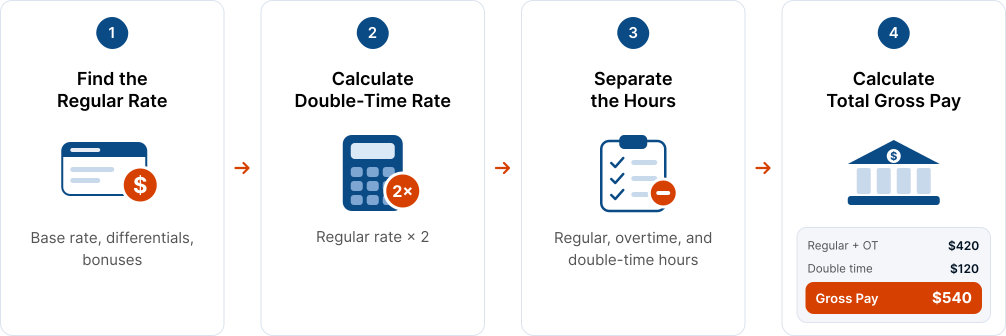
The arithmetic is simple. The part employers get wrong is step one.
Determine the employee's applicable regular rate of pay. Depending on the payment type and applicable law, this may include the base hourly rate, shift differentials, nondiscretionary bonuses, commissions, and piece-rate earnings.
Multiply the employee's applicable regular rate of pay by two to determine the double-time hourly rate.
Identify the employee's regular hours, overtime hours, and double-time hours. Apply the relevant daily and weekly overtime rules and ensure that no hour is counted twice when calculating premium pay.
Multiply the hours in each category by the applicable pay rate, then add the amounts together to determine the employee's gross pay before taxes and deductions.
Double time rate = regular rate of pay × 2
Gross pay = (regular rate × regular hours) + (1.5 × regular rate × overtime hours) + (2 × regular rate × double time hours)

Manage employee hours, earnings, and payroll details in one place. Paywow helps streamline payroll processing so you can spend less time managing payroll tasks.
Alex is a nonexempt employee in California with a regular rate of $30 per hour. Alex works a 14-hour shift in a workday.
| First 8 hours at the regular rate: 8 × $30.00 | $240.00 |
| Hours 9 to 12 at 1.5×: 4 × $45.00 | $180.00 |
| Hours 13 and 14 at 2×: 2 × $60.00 | $120.00 |
| Pay for the day | $540.00 |
Over the same week, John works 8 hours on Monday, 14 hours on Tuesday, and 8 hours each on Wednesday, Thursday and Friday – 46 hours in total.
| Bucket | Hours | Rate | Pay |
|---|---|---|---|
| Straight time | 40 | $30.00 | $1,200.00 |
| Overtime (hours 9 to 12 on Tuesday) | 4 | $45.00 | $180.00 |
| Double time (hours 13 and 14 on Tuesday) | 2 | $60.00 | $120.00 |
| Gross pay for the week | 46 | $1,500.00 |
Marcus earns $20.00 an hour in California. He works 8 hours a day Monday through Saturday, then 10 hours on Sunday, the seventh consecutive day of his employer’s workweek.
| Bucket | Hours | Rate | Pay |
|---|---|---|---|
| Straight time, Monday to Saturday | 40 | $20.00 | $800.00 |
| Weekly overtime, the 8 hours over 40 | 8 | $30.00 | $240.00 |
| Seventh day, first 8 hours at 1.5× | 8 | $30.00 | $240.00 |
| Seventh day, hours 9 and 10 at 2× | 2 | $40.00 | $80.00 |
| Gross pay for the week | 58 | $1,360.00 |
Using the Base Pay Rate Instead of the Regular Rate. Failing to include applicable shift differentials, commissions, and nondiscretionary bonuses can result in incorrect double time calculations.Ignoring Workday and Workweek Boundaries.Treating a workday as a calendar day or overlooking the employer's defined workweek can lead to incorrect overtime and double time calculations.Assuming Salaried Employees Are Exempt. Being paid a salary does not automatically make an employee exempt. Eligible salaried, nonexempt employees may still qualify for double time.Incorrectly Combining Overtime and Double Time Hours. Paying overlapping daily and weekly overtime premiums twice or failing to apply the highest applicable rate can lead to payroll errors.Applying the Same Double Time Rules in Every State. Double time requirements vary by state. Employers must follow the applicable laws based on where employees perform their work.Manage employee payroll details, organize earnings, and keep payroll records in one place with Paywow.
Keep regular hours, overtime, and double time earnings organized. Paywow helps streamline payroll calculations so you can manage employee pay with greater confidence.

Account for applicable overtime and double time rates when processing payroll. Keep employee earnings and pay details organized for easier payroll management.

Maintain organized payroll records, track employee earnings, and simplify your year-end reporting process with Paywow.
Spend less time managing payroll tasks. Organize employee earnings, manage payroll details, and simplify your payroll process with Paywow.